
Cash Feels Safe. But What Does It Cost Over Time?

When it comes to managing money, we sometimes talk about cash and investing as if we have to choose a side.
Should I keep my money safe in cash, or should I invest it?
The answer is usually: both.
Cash and investments serve very different purposes in a financial plan. The key is understanding which dollars need to stay safe and accessible—and which dollars have enough time to be put to work.
Cash Is There When You Need It
There are plenty of good reasons to hold cash.
Your emergency fund should be accessible. Money you're planning to use for a new car next year probably shouldn't depend on what the stock market happens to be doing that month. The same might be true for a home renovation, a big trip, or another expense coming up soon.
Especially as you approach retirement, having appropriate cash reserves can give you flexibility when markets are down.
In other words, cash has a job.
The problem comes when money intended for long-term goals stays in cash simply because cash feels safer.
Over a few months, that may not make much difference. Over a few decades, it can make an enormous one.
What $100,000 Can Look Like Over Time
Here's a great example.
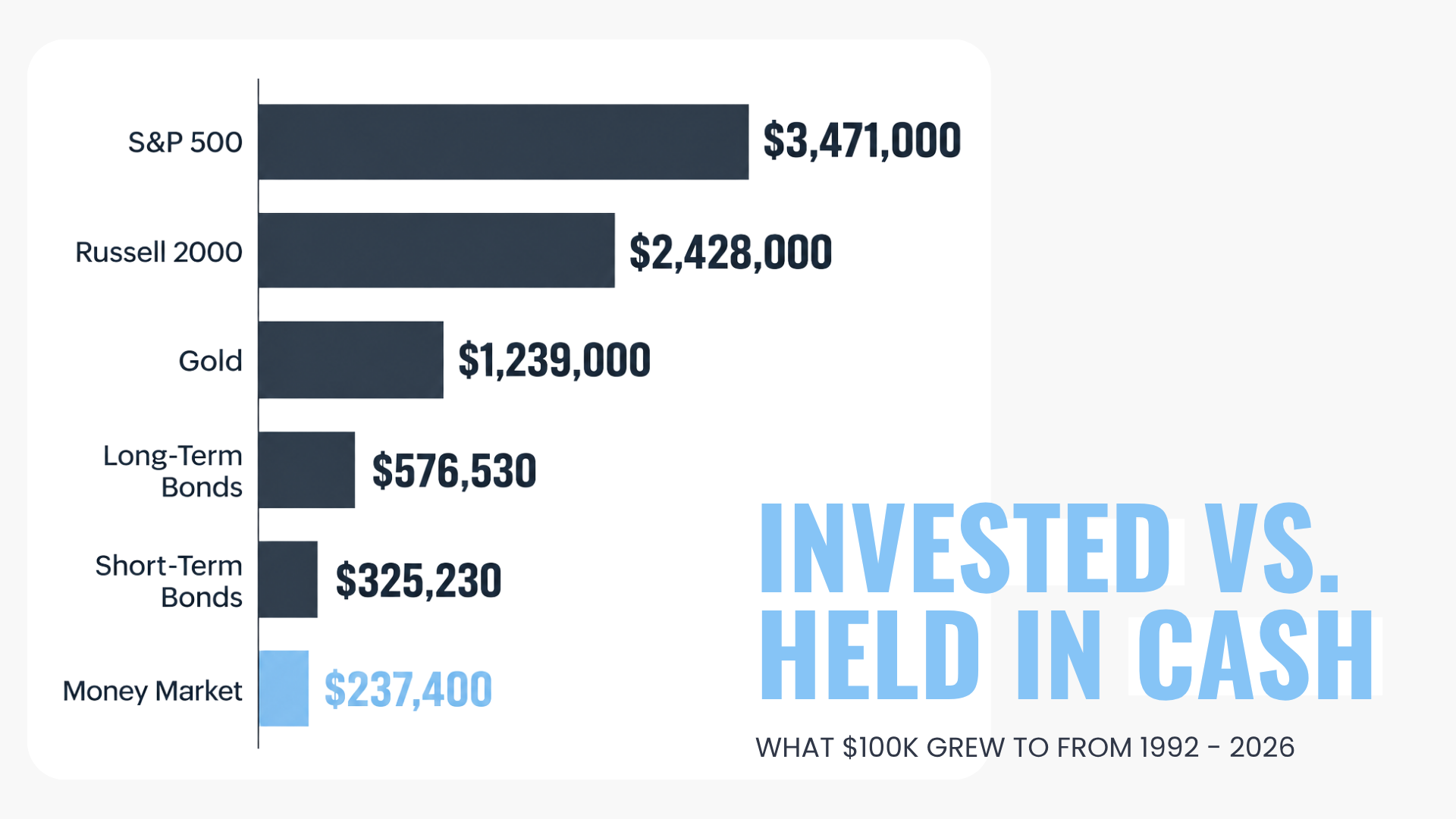
If $100,000 had been invested in the S&P 500 in May 1992, by June 2026 it would have grown to approximately:
$3,471,000.
Over that same period, $100,000 in a money market fund would have grown to approximately:
$237,400.
That's a difference of more than $3.2 million.
Of course, the journey wouldn't have been smooth. During those 34 years, investors experienced the dot-com crash, the Great Financial Crisis, COVID-19, inflation, changing interest rates, wars, elections, and plenty of days when the headlines gave people a reason to worry.
There were periods when holding cash probably felt pretty good.
But that's part of this idea.
Long-term investing isn't about avoiding every uncomfortable period, it's about giving your money enough time to participate in long-term growth.
The Cost We Don't Always See
When people think about investment risk, they naturally think about losing money.
There's another type of risk that's easier to overlook: the risk of not growing enough.
Imagine you're 55 and have $500,000 sitting in cash. You're planning to retire around age 65, so you still have roughly a decade before retirement—and potentially another 20 or 30 years after that.
Keeping all $500,000 in cash might feel conservative. But that money also needs to help support decades of future spending while keeping up with rising prices.
Something that costs $50,000 per year today probably won't cost $50,000 per year 15 or 20 years from now.
That's why we don't just ask:
"How do we keep this money safe?"
We also need to ask:
"What does this money need to accomplish?"
Those can lead to very different decisions.
Give Every Dollar a Job
One way to make this simpler is to think about your money in buckets based on when you'll need it.
Money you may need soon: Cash can make a lot of sense. Emergency savings, upcoming purchases, and near-term spending should generally prioritize accessibility and stability.
Money you'll need in the next several years: This may call for a more balanced approach depending on your situation, timeline, and comfort with market fluctuations.
Money you won't need for many years: This is where investing and long-term growth become especially important.
For someone approaching retirement, this can be particularly helpful. Retirement doesn't mean every dollar suddenly becomes short-term money on your last day of work.

You might need some of your savings next year—but another portion may not be touched for 10, 15, or even 20+ years.
Those dollars don't necessarily need to be invested the same way.
It's Not Cash vs. Investing
We don't think the lesson is that cash is bad or that every available dollar should be invested.
Quite the opposite.
Having the right amount of cash can be an important part of a good financial plan. The goal is to be intentional about how much you hold and why you're holding it.
Because cash has a purpose.
Investing has a purpose.
And when each dollar is given the right job, your financial plan can do a much better job of supporting both the life you're living today and the one you're planning for tomorrow. Which is the goal, right?
The examples above are for educational purposes only. Past performance is no guarantee of future results. You cannot invest directly in an index. Investing involves risk, including possible loss of principal.