
Navigating the Latest Economic Trends: What You Need to Know
Economic updates this past week provided new insights into how the U.S. economy is evolving and reminded us just how dynamic the financial landscape can be. While some numbers raised eyebrows, others offered encouraging signals for consumers, investors, and businesses alike.
Let’s break it down.
U.S. GDP Shows a Temporary Dip, Driven by Smart Business Planning
The U.S. economy experienced a modest contraction of 0.3% in the first quarter of 2025, the first since 2022. But the story behind the numbers tells us more than the number itself.
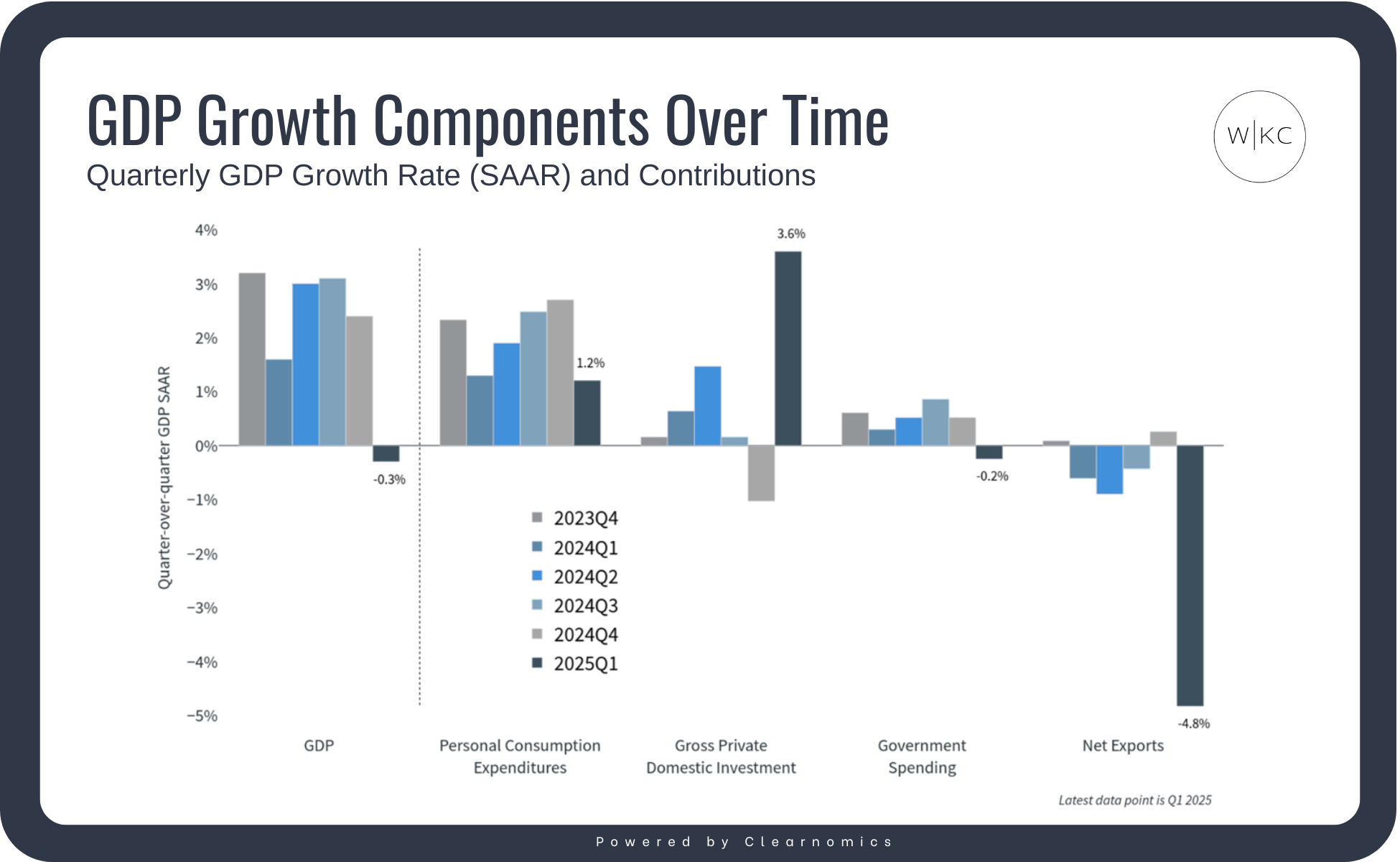
A surge in imports primarily drove this dip, as businesses strategically brought in goods ahead of newly announced tariffs. In fact, imports rose over 41%, a significant jump that reflects proactive inventory planning rather than any decline in demand. Because imports subtract from GDP calculations, this one-time shift temporarily impacted overall economic growth.
What this shows is that businesses are planning ahead and responding to trade changes with agility—a healthy sign of adaptability and resilience.
Bridging the Gap Between Confidence and Action
For much of the past year, there’s been a noticeable difference between what consumers and business owners say they feel, and what they actually do. While some sentiment surveys have reflected caution, consumer spending and business activity have generally remained steady.
Now, with this latest data, we’re seeing alignment between soft data (like confidence levels) and hard data (like GDP). This helps paint a clearer picture of the current environment and supports more informed decisions in the months ahead.
Encouraging News on Inflation
One of the most welcome developments came in the latest inflation numbers. The Consumer Price Index (CPI) for March showed a slight decrease of 0.1%, bringing the year-over-year rate down to 2.4%—lower than many expected.
This progress signals that inflation pressures are continuing to ease, helping consumers maintain their purchasing power. It also creates more flexibility for future policy decisions, giving markets and households additional breathing room.
Put simply: prices are stabilizing, and that's good news for everyone.
Europe Sees Growth Pick Up
Across the Atlantic, the Eurozone economy grew by 0.4% in the first quarter of 2025, double the growth of the prior quarter. This improvement shows the global economy remains in motion, and that strength can be found in a variety of regions and sectors.
While global trade and investment trends continue to evolve, the momentum abroad adds a broader sense of balance and opportunity to the overall economic picture.
What This Means for You
These developments, when considered together, underscore the necessity of remaining flexible, informed, and aligned with our long-term goals. Economic cycles are constantly shifting, and with careful planning, you can navigate them confidently. A crucial aspect of our process involves consistently seeking hard data and being patient enough to wait for it. Inflation serves as a prime example; surveys indicate that inflation is expected to rise, while the actual data reveals that it is decreasing. Numbers don’t lie.
Process over predictions.
Shean