
Supreme Court Tariff Ruling: Key Takeaways for Investors
After almost a year of uncertainty around trade policy, the Supreme Court’s decision to strike down the latest tariffs has changed the conversation.
But as we’ve seen time and again in Washington, when one issue gets resolved, another quickly takes its place. President Trump has already indicated he plans to use a different legal approach to keep tariffs in play, and the markets are still sorting through what that could mean for trade, company profits, consumer spending, and investment portfolios.
The biggest takeaway isn’t really about the legal details, it’s about what the past year has shown us—staying invested matters.
Markets can swing during times of policy uncertainty, but they also have a history of settling down and recovering when it feels least expected. Tariffs will likely continue to make headlines, but understanding how the last year unfolded can help long-term investors keep perspective as this next phase develops.
A Year of Tariff Volatility
To understand what this ruling means for investors, it helps to know that presidents have a few different legal ways to put tariffs in place, each with its own limits on size and timing.
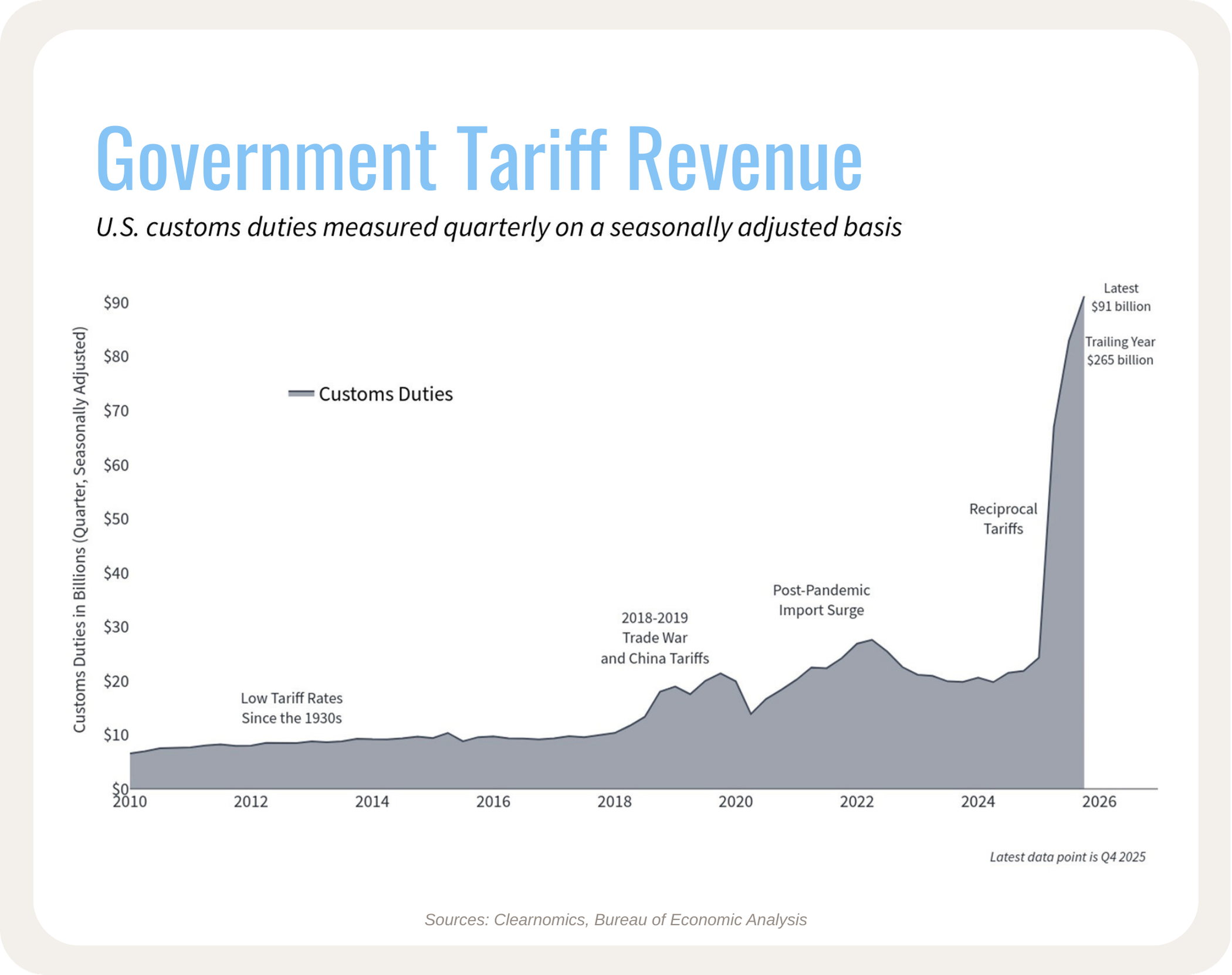
Last April’s “reciprocal tariffs” were introduced under a law called IEEPA, which allows a president to regulate trade during a declared national emergency. The administration cited trade deficits, drug trafficking, and immigration as the reasons.
Here’s the short version of what happened:
April 2, 2025: A 10% baseline tariff was announced on most trading partners, with higher rates for some countries. Markets dropped quickly, and investors worried about slower growth and higher inflation at the same time.
April 9, 2025: Just a week later, the higher country-specific tariffs were paused for 90 days, leaving only the 10% rate. Markets rebounded and eventually reached new highs.
February 20, 2026: The Supreme Court ruled that the administration didn’t have the authority under IEEPA to impose such broad tariffs, reinforcing Congress’s role in trade policy.
Overall, it’s been a year of rapid changes, sharp market reactions, and now clearer guidance on how trade policy can move forward.
Tariffs are unlikely to go away
The administration anticipated this ruling and had a backup plan ready. After the Supreme Court’s decision, it quickly turned to a different law, Section 122 of the Trade Act of 1974, which allows tariffs to be applied to multiple countries without a long investigation process.

Under this law, the president can impose tariffs of up to 15% for 150 days without Congress signing off first. It’s meant to provide short-term flexibility while keeping Congress involved over time.
So even if some of the higher 2025 tariffs are scaled back and the new ones are temporary, tariffs are likely to remain part of the picture. Businesses and investors should expect continued negotiations and some uncertainty.
There’s also the question of refunds. Courts still have to decide whether companies that paid tariffs under the previous rules will get reimbursed, and whether individuals would receive anything. That could take a while. If refunds are approved, though, they could offer a meaningful boost to businesses and consumers.
The economy does not always follow textbook theory
Economics is sometimes called the “dismal science” because it’s not very good at predicting exactly how things will play out after big policy changes. When tariffs rose to their highest levels since the Great Depression, many experts warned we’d see slower growth, higher inflation, and struggling markets.

That worst-case scenario never fully happened.
For one, the tariff rules kept changing. The 90-day pause announced just a week after Liberation Day reduced much of the immediate impact, and many of the highest rates never fully took effect.
Businesses also adapted quickly. Many imported goods ahead of the deadlines, which helped soften the short-term impact on prices.
Most importantly, the overall economy remained solid. Inflation continued to cool, growth stayed positive, and corporate earnings held up. Strong fundamentals helped steady the markets.
Tariffs did have a cost, and businesses and consumers ultimately paid it. But the past year is a good reminder that headlines often paint a more dramatic picture than reality.
In the end, it’s important to separate politics from portfolios. Trade debates and legal battles may dominate the news, but long-term investment success is driven far more by economic fundamentals, corporate earnings, and disciplined strategy.
Process over predictions.
Shean