
The Bulls Near-Term Objective
Markets leave “footprints” that reveal where buyers and sellers have drawn their lines in the sand, and on the hourly chart of the S&P 500, the most prominent footprint right now sits at 5,500.
In late March, the index slipped to that level and immediately bounced (green flags)—clear evidence that investors considered 5,500 a bargain. Yet after the mid-April pullback, the same level turned into a ceiling (red flags). Each subsequent rally has stalled right at that prior floor, illustrating a classic market dynamic in which broken support becomes resistance as former buyers look to exit around breakeven.
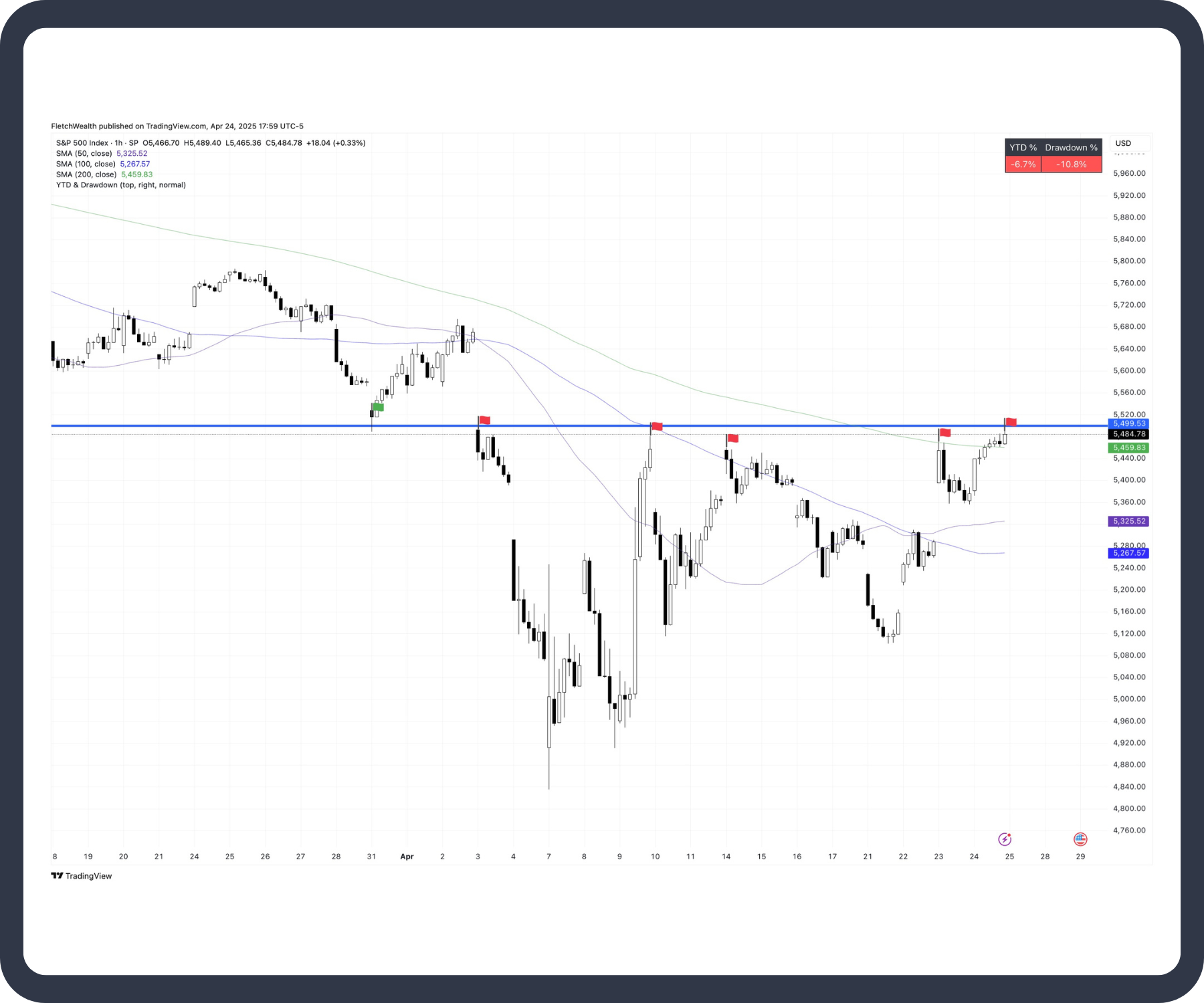
A decisive close above 5,500 would therefore be more than a cosmetic victory. It would signal that demand has grown strong enough to absorb the lingering supply from those earlier reversals, suggesting the April correction is giving way to renewed accumulation.
Confirmation, however, will require more than an isolated spike; we will be watching for sustained trade above 5,500 accompanied by healthy volume and, ideally, leadership from economically sensitive groups such as industrials, small caps, and other cyclicals. Earnings releases and the forthcoming batch of inflation data could still sway sentiment, but a breakout through 5,500 would significantly improve the market’s technical posture heading into those catalysts.
None of this alters our long-term allocations at the moment; there is still a lot of information to come and digest. Monitoring levels like 5,500 help us judge whether recent weakness is simply a pause in an ongoing advance or the start of something more concerning. Should the S&P 500 clear this hurdle, it would add weight to the more optimistic ledger, but a turnaround at this level would indicate more weakness could be ahead.
Process over predictions.
Shean