
The Lost Decade Pt. 5—Strategies for Retirees
Welcome to our 5-part blog series on “The Lost Decade”—a period when the S&P 500 went ten long years without delivering real gains.
These blogs explore the key lessons this challenging chapter in market history can teach us, and share practical strategies to help you safeguard your investments if, or when, another period like this comes around.

We don’t know what the markets will do next year—let alone over the next ten. But we do know that long periods of weak or volatile performance can happen. The early 2000s gave us a vivid reminder.
For retirees, the key question isn’t “Will that happen again?”
It’s: “If it does, am I prepared?”
Here are some practical ways to strengthen your retirement plan in case the market delivers another long, bumpy ride:
1. Right-Size Your Allocation Before Retirement
One of the most common risks we see is heading into retirement with too much stock exposure. The 2000s showed how a downturn early in retirement can take a lasting toll. That’s why it’s so important to align your mix of stocks and bonds with your risk tolerance and income needs.
For many, that means increasing your allocation to high-quality bonds and stable assets in your 50s and 60s. Cash reserves, Treasury bonds, or TIPS, can act as a cushion if stocks go flat or fall.
The goal? Your plan can stay intact even if the market goes nowhere for a decade.
2. Diversify Beyond U.S. Large-Cap Stocks
The S&P 500 isn’t the whole market; the 2000s proved it. U.S. large caps were flat for a decade, but many other asset classes had positive returns: international stocks, small caps, real estate, commodities, and gold.
A diversified portfolio spreads your risk and gives you more chances that something in your plan is doing well at any given time. That reduces the volatile swings and makes staying on track emotionally and financially easier.
3. Have a Well-Designed and Thought-Out Income Plan
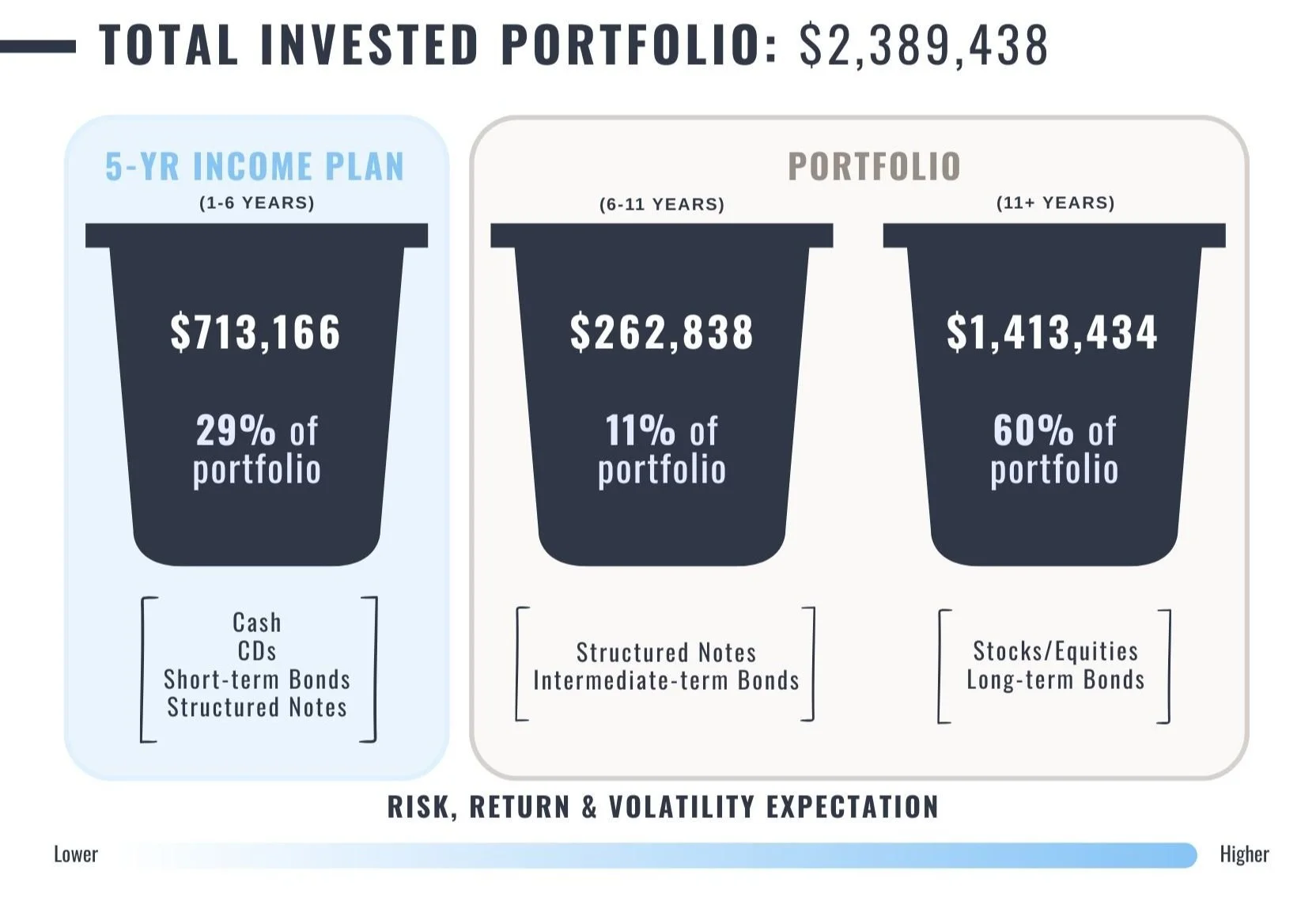
One proven way to protect your retirement income in a downturn is to keep a few years’ worth of withdrawals in ultra-safe assets like cash or short-term bonds. This “bucket” gives you breathing room when stocks fall—you can pull from the reserve instead of selling investments at a loss.
This helped many retirees ride out the 2000s without derailing their plans.
We call our retirement income strategy a 5-Year Income Plan; an example of that design is below.
4. Be Flexible with Withdrawals
One of the most powerful tools retirees have is flexibility. If returns are poor for a while, consider temporarily trimming your withdrawal rate—maybe pausing inflation adjustments or dialing back to 3% for a few years. Small adjustments can dramatically extend the life of your portfolio.
In contrast, rigidly sticking to a 4% withdrawal no matter what the market’s doing can backfire—especially during a tough decade.
5. Stick to Your Plan and Rebalance
Having a written investment plan isn’t just a formality—it’s a guide to follow when emotions run high. Set up automatic rebalancing if possible, or plan to check in on a regular schedule. Rebalancing forces you to buy low and sell high, which is the opposite of what emotions usually tell us to do.
In the 2000s, investors who rebalanced during downturns often ended up ahead of those who didn’t. Discipline matters—especially when it’s uncomfortable.
6. Don’t Chase Risky “Solutions”
When markets are tough, it’s tempting to reach for yield or try to time your way around losses. But chasing high-yield bonds, piling into “safe” sectors, or shifting in and out of the market often creates more problems than it solves.
In 2008, many assets fell together—but high-quality Treasury bonds held up. Simple, boring diversification worked. And if you need to do something in a downturn, focus on smart moves like tax-loss harvesting or Roth conversions while valuations are low.
7. Don’t Go It Alone if You’re Unsure
There’s no shame in asking for help—especially when markets are volatile and decisions feel weighty.
Behavioral mistakes (like selling at the bottom) can be far more costly than paying for professional advice and guidance. If you’re unsure, put support systems in place before emotions take over.
The early 2000s were a tough stretch for retirees, but not hopeless. Those who came in overexposed to stocks and reacted emotionally often struggled to recover. But those who came in with a thoughtful plan, stayed diversified, and made measured adjustments when needed, weathered the storm just fine.
The big takeaway: You can’t predict the next lost decade, but you sure can prepare for it.
Process over predictions.
Shean