
How the Dollar, Gold, and International Stocks Shape Global Portfolios
Global events have been driving much of what we’re seeing in the markets lately.
Oil prices, geopolitical tensions, and tariffs are getting most of the attention, but there’s another important force working in the background—the U.S. dollar.

Even when it’s not making headlines, the dollar plays a meaningful role in portfolios. It influences international investments, commodities like gold, and the broader economic environment. Taking a step back to understand it can help put recent market movements into better perspective.
After peaking in 2022, the dollar declined as global growth stabilized and investors began looking beyond U.S. assets. More recently, it has rebounded, reflecting its role as a safe haven during uncertain times.
When markets feel unsettled, investors often move toward the dollar.
What to know about the dollar right now
First, a stronger dollar isn’t always a clear positive.
While it can make imports cheaper and international travel more affordable, it can also create challenges for U.S. companies by making their goods more expensive overseas.
There’s a natural balance here between what’s good for consumers and what supports businesses and economic growth.
Second, the dollar is influenced by many global factors.
Interest rates, trade policy, and government spending all play a role. Over the past few years, we’ve seen meaningful shifts, from rapid rate hikes to a pause in Fed policy, along with the introduction of new tariffs.
At the same time, concerns about long-term fiscal deficits may come back into focus, which can also influence how investors view the dollar.
Third, the dollar still tends to strengthen during periods of uncertainty.
We’ve seen that again this year. Despite ongoing conversations about whether its global dominance could change over time, the dollar remains the world’s primary reserve currency and continues to attract investors during volatile periods.
Why this matters for your portfolio
The dollar’s movement has a direct impact on international investments.
When you invest outside the U.S., you’re also investing in foreign currencies. If the dollar weakens, those investments can benefit when converted back into U.S. dollars. That helped support strong international returns last year and is a good reminder of why diversification matters.
Valuations also play a role. International markets have generally traded at lower valuations than U.S. stocks, which can be an important consideration when building a balanced portfolio. So far this year, international markets have continued to hold up relatively well, even as the dollar has regained some strength.
After a long stretch of U.S. market leadership, this shift is a helpful reminder that leadership rotates over time. Staying globally diversified can help smooth out those changes.
A quick note on gold
Gold has also been influenced by many of the same forces as the dollar.
It saw a strong run over the past few years, supported by factors like geopolitical uncertainty and concerns about government spending. More recently, though, it has pulled back, even with many of those themes still in place.
That’s not as unusual as it might seem.
When an asset becomes widely owned, its price movements can start to align more with broader markets. During periods of stress, investors may sell gold alongside other assets, especially if they’re moving back into the dollar.
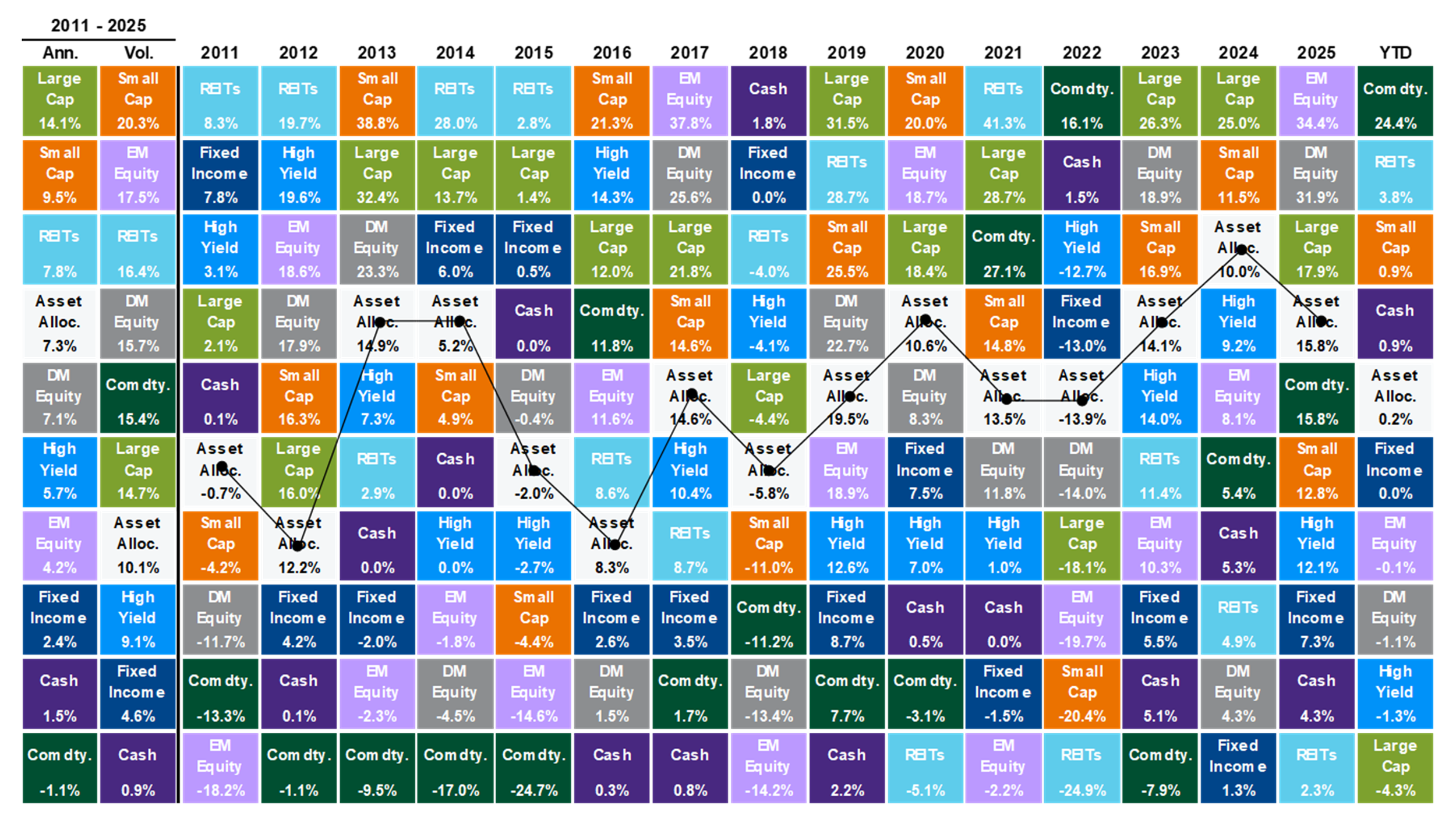
This chart shows annual returns by asset class from 2011 through 2025 (plus year-to-date), with each color representing a different asset category. The boxes are ranked each year from highest return at the top to lowest at the bottom, which highlights how market leadership changes over time. The black line tracks a diversified “asset allocation” portfolio, illustrating how diversification can help smooth returns compared with any single asset class.
As always, the more useful lens is to view the dollar, international investments, and gold as parts of an overall portfolio rather than as standalone investments. The value of these assets is in the fact that they behave differently than stocks and bonds, and can help to stabilize portfolios over time. They won’t always move in sync, and they won’t always behave the way we expect in the short term.
That’s exactly what makes them valuable together.
Process over predictions.
Shean