
Don't Let the Headlines Run Your Portfolio
Why your investment strategy must be built on decades of data — not today's news cycle.
This morning, at the time of writing, the S&P 500 was up nearly 2% — hovering around 6,635. The Dow had surged over 1,000 points. The Nasdaq was soaring. By almost any measure, it was a great day to be invested in the stock market.
But here's the part that should give every investor pause: this morning almost didn't happen the way it did.
What Happened This Morning (March 23, 2026)
Before the opening bell, stock futures had tanked. Sentiment was deeply negative after Iran launched strikes despite warnings from President Trump. Fear was in the air, and the early indicators looked grim — exactly the kind of morning that makes investors want to hit the sell button.

Then, before markets opened, Trump announced he was postponing the strike, describing the U.S.-Iran talks as "very good."
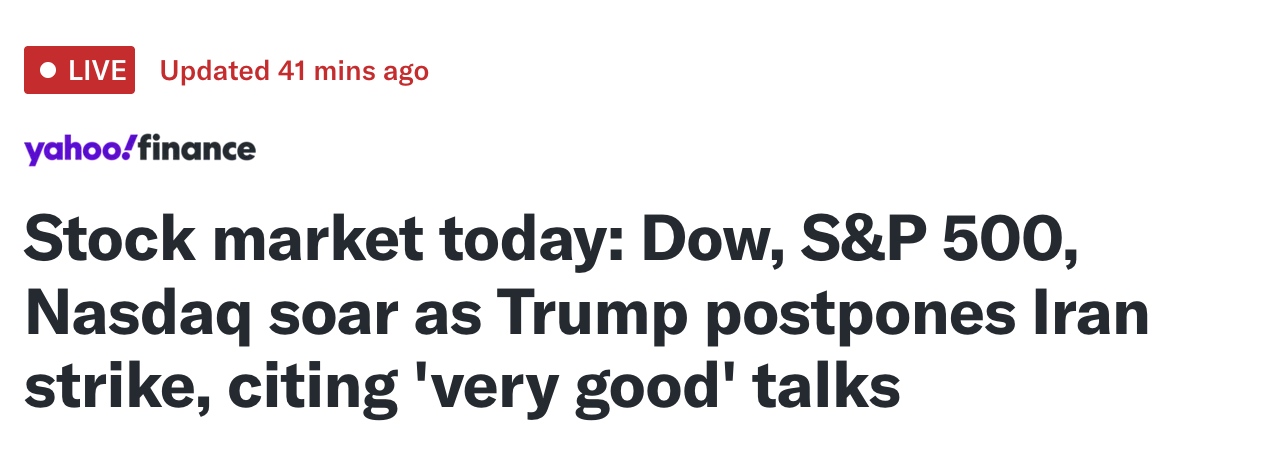
Within hours, the Dow was up 900 points at the open. The S&P 500 climbed nearly 2%. The narrative had flipped entirely — not because of any change in economic fundamentals, earnings reports, or long-term data, but because of a single statement from one person.

This Is the Noise — Don't Mistake It for Signal.
Markets are emotional in the short term. They react to tweets, press conferences, geopolitical headlines, and the mood of a handful of policymakers. In the span of a single morning, we witnessed a swing from fear to euphoria — not because the economy changed, but because a leader said something.
If you had sold your holdings last night in response to the futures drop, you would have locked in losses and missed the rally entirely. If you panic-bought this morning in response to the surge, you may be buying near a short-term peak driven by sentiment, not value.
This is exactly why making financial decisions based on the news cycle is so dangerous.
What Long-Term Data Actually Tells Us
Let's zoom out. The S&P 500 has an average annualized return of approximately 10% over the past century — including world wars, recessions, pandemics, presidential assassinations, financial crises, and countless days that looked just like today.
Consider these truths that have stood the test of time:
1. Time in the market beats timing the market.
A landmark study by Charles Schwab found that even investors with the worst possible timing — buying at every market peak — still outperformed those who stayed in cash over long periods. The cost of being out of the market even for a handful of its best days is enormous.
2. Volatility is the price of admission for long-term returns.
Corrections of 10% or more happen roughly once a year on average. Bear markets (drops of 20%+) occur every 3–5 years. They feel catastrophic in the moment. Over time, they are buying opportunities for the patient investor.
3. Geopolitical events rarely derail long-term market trends.
Research consistently shows that military conflicts, political turmoil, and international crises — while jarring in the short term — have historically had minimal lasting impact on diversified portfolios. Markets tend to recover, often faster than expected.
4. Emotional investing systematically destroys wealth.
DALBAR's annual Quantitative Analysis of Investor Behavior study has repeatedly shown that average investors dramatically underperform the market indices they invest in — primarily because they buy high and sell low in response to fear and greed.
What a Real Financial Plan Looks Like
A sound financial plan doesn't have a "what to do when Iran launches strikes" clause. It doesn't change based on who is president, what the Fed chair said last Tuesday, or whether the futures market is up or down before breakfast. It is built on answers to questions like these:
— What are my specific financial goals — retirement, education, legacy — and when do I need the money?
— What is my true risk tolerance — not the one I claim in a bull market, but the one that holds up when I watch my portfolio drop 30%?
— What asset allocation gives me the best probability of achieving my goals within my risk parameters?
— How will I rebalance systematically, not reactively?
— What is my plan for contributions and withdrawals, and how does it account for taxes and inflation?
None of those questions are answered by the morning's headlines. And none of those answers should change because of them.
Build an Investment Philosophy To Weather Every Storm
An investment philosophy is more than a strategy. It is a set of deeply held, evidence-based beliefs about how markets work and how you will behave inside of them. It is written in calm water so it can be referenced in the storm.
A strong investment philosophy typically includes:
■ A belief in the long-term growth of the global economy.
Capitalism has proven remarkably resilient over centuries. Companies adapt, innovate, and grow earnings over time. That is the engine behind long-term equity returns.
■ A commitment to diversification.
No single stock, sector, or country should be able to derail your financial future.
■ A defined response to volatility.
Know in advance what you will do when markets fall 20%, 30%, or 40%. Will you rebalance into equities? Stay the course? The answer should be predetermined — not decided in the heat of the moment.
■ A skepticism of market timing.
Decades of research show that almost no one — professional or amateur — can consistently predict short-term market movements. Build a plan that does not require you to be right about what the market will do next week.
■ A fee- and tax-aware mindset.
Every dollar lost to unnecessary fees or avoidable taxes is a dollar that does not compound over time. Long-term investors keep costs ruthlessly low.
Today, the stock market soared because a political leader postponed a military action. Tomorrow, something else will happen. A jobs report will disappoint. A central bank will surprise. A company will miss earnings. A conflict will escalate.
The world will always provide a reason to be scared and a reason to be euphoric. Markets will always overreact to both. And investors who let those reactions drive their decisions will always, on average, underperform those who don't.
We cannot afford to make quick, non-data-driven decisions out of emotion — especially in a world where a single leader's statement can swing the market by hundreds of points in a matter of hours.
That is not investing. That is gambling with the news.
Build your plan on decades of data. Anchor your philosophy to evidence, not emotion. And then — when the headlines scream — let the plan do its job.
As always, process over predictions.
Shean
This post was written at 10:15 AM CT.