
The Lost Decade Pt. 3—Sell at the Bottom or Stay the Course? A Tale of Two Retirees
Welcome to our 5-part blog series on “The Lost Decade”—a period when the S&P 500 went ten long years without delivering real gains.
These blogs explore the key lessons this challenging chapter in market history can teach us, and share practical strategies to help you safeguard your investments if, or when, another period like this comes around.

When markets take a nosedive, it’s natural to feel the urge to hit the eject button. But history shows that for retirees, the decision to sell or stay invested can lead to drastically different outcomes.
Take the 2008–2009 financial crisis. It was a brutal period for investors, especially those already in or near retirement. Some stayed the course, while others panicked and moved to cash.
(Before moving on, let’s remember the original data we used from Parts 1 and 2. We’re using an example of someone who retired on 01/01/2000 and went through the lost decade, withdrawing 4% ($40,000) and then increasing those withdrawals by 2.85% with inflation, from a 60% stock, 40% bond portfolio, every year for 25 years until 12/31/2024.)
Here’s how a few other choices played out using our $1,000,000 portfolio example:
Stayed Invested:
Someone who stayed invested the entire time would have $846,705 left in their portfolio after withdrawing almost $430,000 MORE than their original $1,000,000 portfolio ($1,430,000 in total withdrawals).
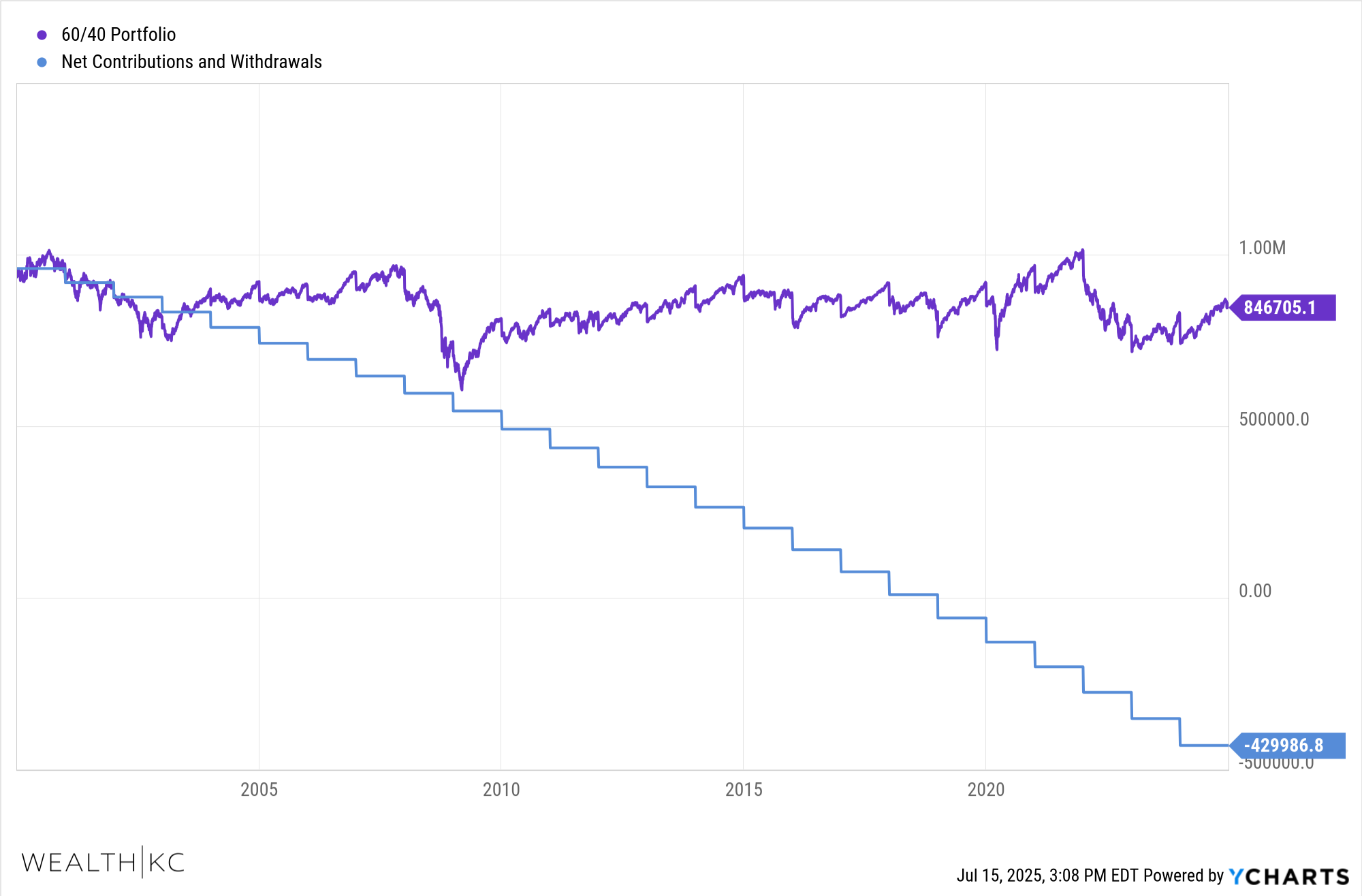
Blue Line-Net Contributions: $1,000,000 starting portfolio on 01/01/2000 minus withdrawals.
Purple Line- 60/40 Portfolio: The amount of money still remaining in your portfolio after withdrawals and market gains/losses.
Sold at the Bottom: If that same investor had panicked or just given up and cashed out on March 9th, 2009, the bottom of the Great Recession, they would have stopped the losses and had $605,823, as shown in the chart below.
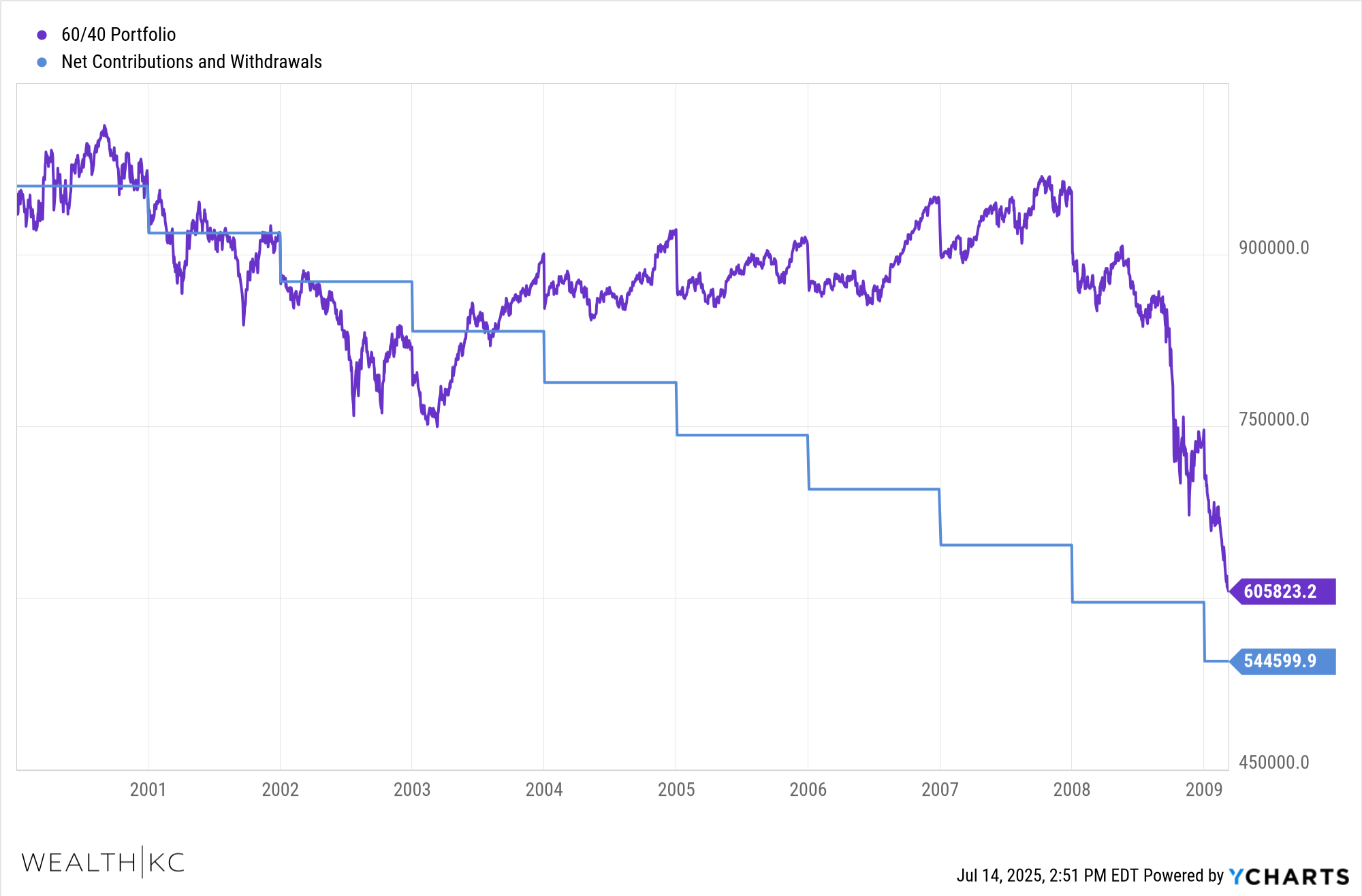
Blue Line-Net Contributions: $1,000,000 starting portfolio on 01/01/2000 minus withdrawals.
Purple Line- 60/40 Portfolio: The amount of money still remaining in your portfolio after withdrawals and market gains/losses.
Who knows when or if this person would have gotten back in, but for this example, let's assume they waited a very short time, until the end of the year, and re-entered on January 1st, 2010, with their $605,823. After continuing the 4% withdrawals and sitting out for the rest of 2009, their portfolio would have only grown to $622,077 by the end of their first 25 years of retirement. That’s a staggering $224,628 less than if they had just stayed invested in their 60/40 stock-to-bond portfolio in the example above. The difference is simply astonishing. Could you imagine if they had waited even longer?
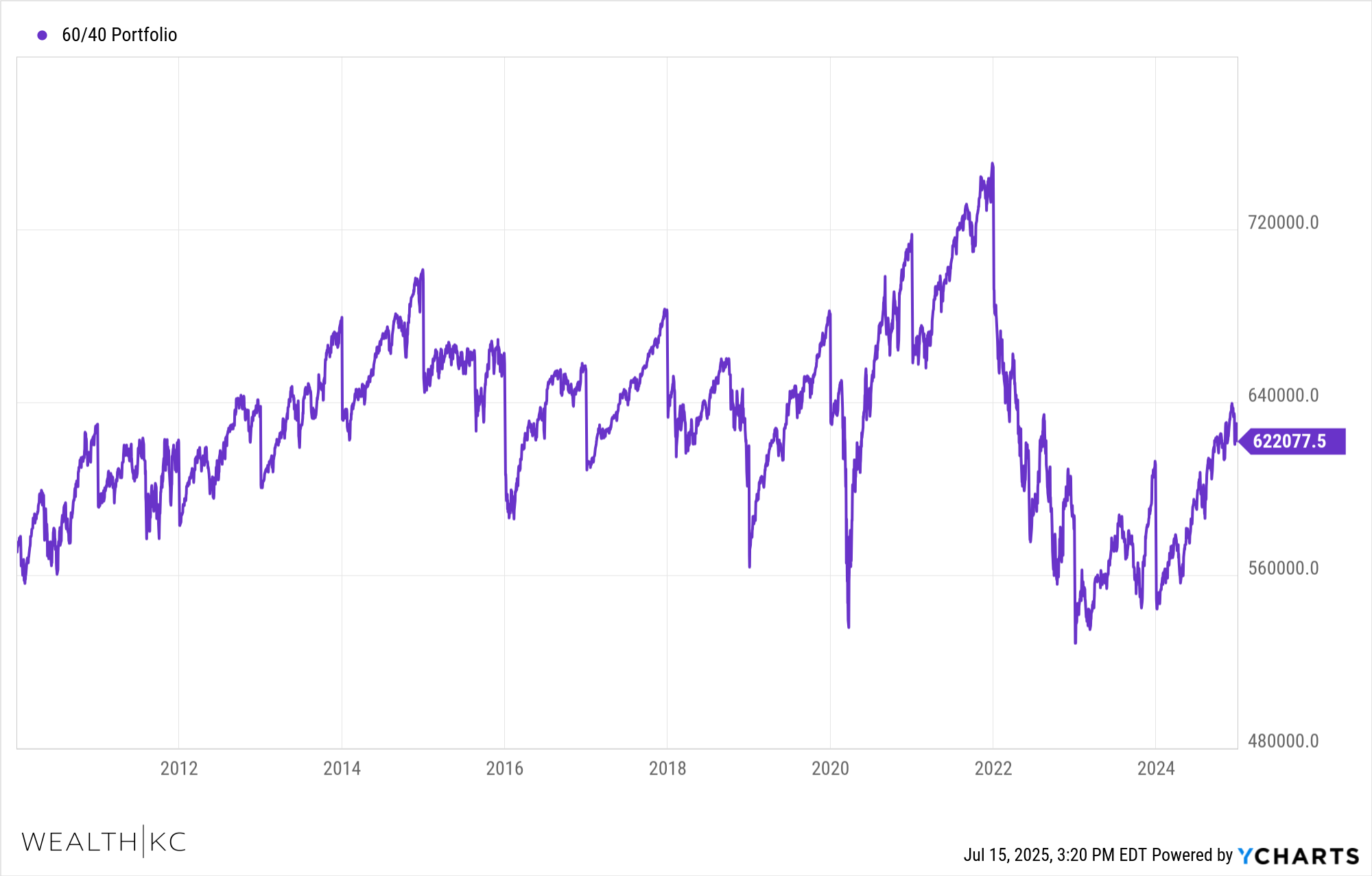
Purple Line- 60/40 Portfolio: The amount of money still remaining in your portfolio after withdrawals and market gains/losses from 01/01/2010.
When markets take a nosedive, it’s natural to feel the urge to hit the eject button. However, history shows that the decision to sell or stay invested for retirees can lead to drastically different outcomes.
The investors who stayed invested ultimately recovered and moved forward.
Those who jumped out missed the recovery and paid the price.
Unfortunately, many retirees didn’t stay the course. IRS data from the 2008 crash shows older investors were more likely than others to sell stocks during the worst of the downturn. And it’s understandable—double-digit losses and scary headlines can trigger a robust emotional response. When you rely on your portfolio for income, “stop the bleeding” can feel like the only option. But selling during a downturn often makes a temporary dip permanent.
And here's another challenge—once you move to cash, you still have to decide when to get back in. That’s not easy, and many investors wait too long or miss the rebound entirely. Just missing the first year of a recovery can severely impact long-term results.
Why Diversification Mattered in the 2000s
Another key takeaway from that tough decade? Diversification works.
Investors who were all-in on the S&P 500 saw flat returns from 2000 to 2009. But those who held a more diversified portfolio—one that included small-cap stocks, international markets, real estate, bonds, or commodities—fared much better. In fact, gold returned an average of about 15% per year during that time, and bonds served as a much-needed anchor in portfolios.
For example, high-quality U.S. Treasury bonds rose sharply in 2000 and again in 2008, notably when stocks tanked. A classic 60/40 stock-bond mix actually eked out a small gain over the decade, while an all-stock portfolio went nowhere.
Diversification didn’t eliminate losses during bear markets, but cushioned the blow. That stability can be incredibly valuable for retirees. In tough markets, bonds or fixed income can serve as a buffer and ballast.
The Power of Rebalancing
Diversification also opens the door to something else: rebalancing. During big market swings, rebalancing means trimming what’s gone up and buying more of what’s gone down—something that’s easy to say and hard to do. But it works.
Consider two hypothetical 60/40 portfolios from 2000 to 2009. The one that was rebalanced regularly actually ended up with a bit more money than the one that wasn’t, because the investor was consistently “buying low” in a disciplined way.
The 2000s were a stress test, and they reinforced some timeless lessons. Staying invested matters, as does diversification. Having a steady hand during turbulence is also important. While we can’t predict markets, we can plan for uncertainty with a portfolio built to endure it.
Process over predictions.
Shean