
Why This Holiday Season Offers Investors Much to Appreciate

As the holiday season gets underway, it’s a great moment to slow down and appreciate where we are—personally and financially.
As investors, we often zero in on what might go wrong, instead of recognizing what’s gone well. Looking back at the past year can offer helpful perspective as we prepare for whatever comes next.
Financial markets have continued their long history of delivering solid results, and this year has followed that trend.
The S&P 500 is up more than 15% with dividends, and bonds have gained roughly 7% based on the Bloomberg U.S. Aggregate Bond Index. International stocks have even outpaced U.S. stocks for the first time in quite a while. Many diversified portfolios have benefited from this broad momentum across asset classes.
Here are some items to appreciate from the past few years:
We have entered the fourth year of the bull market
This year’s performance is something to appreciate, especially given the ups and downs along the way. The current bull market, which began after the October 2022 lows, is now moving into its fourth year.

While nothing is guaranteed, history shows that bull markets tend to last far longer than bear markets—often five to ten years or more. And typically, the gains accumulated over a full bull cycle are far larger than what we’ve seen so far in this one.
There are valid conversations around valuations and market concentration, but long-term investing always requires us to stay steady through a mix of market environments.
The recovery in the bond market is also worth highlighting. After a tough stretch marked by rising rates and high inflation, stabilization in rates and the Fed’s shift toward easing have helped bond prices rebound. This is a good reminder of why a mix of stocks and bonds remains essential for balance and income.
Altogether, this year reinforces a familiar lesson: timing the market around short-term news rarely works. Even in April, when markets dipped near bear-market levels following new tariff announcements, the rebound was swift—and markets pushed to new highs.
Investors who stayed disciplined benefitted, while those who stepped aside may still be waiting to get back in.
Inflation has improved and the Fed is cutting rates
Inflation has cooled meaningfully, even if it’s not as fast as most would like. Prices are up about 3% over the past year—still a challenge, but far more stable compared to earlier spikes.
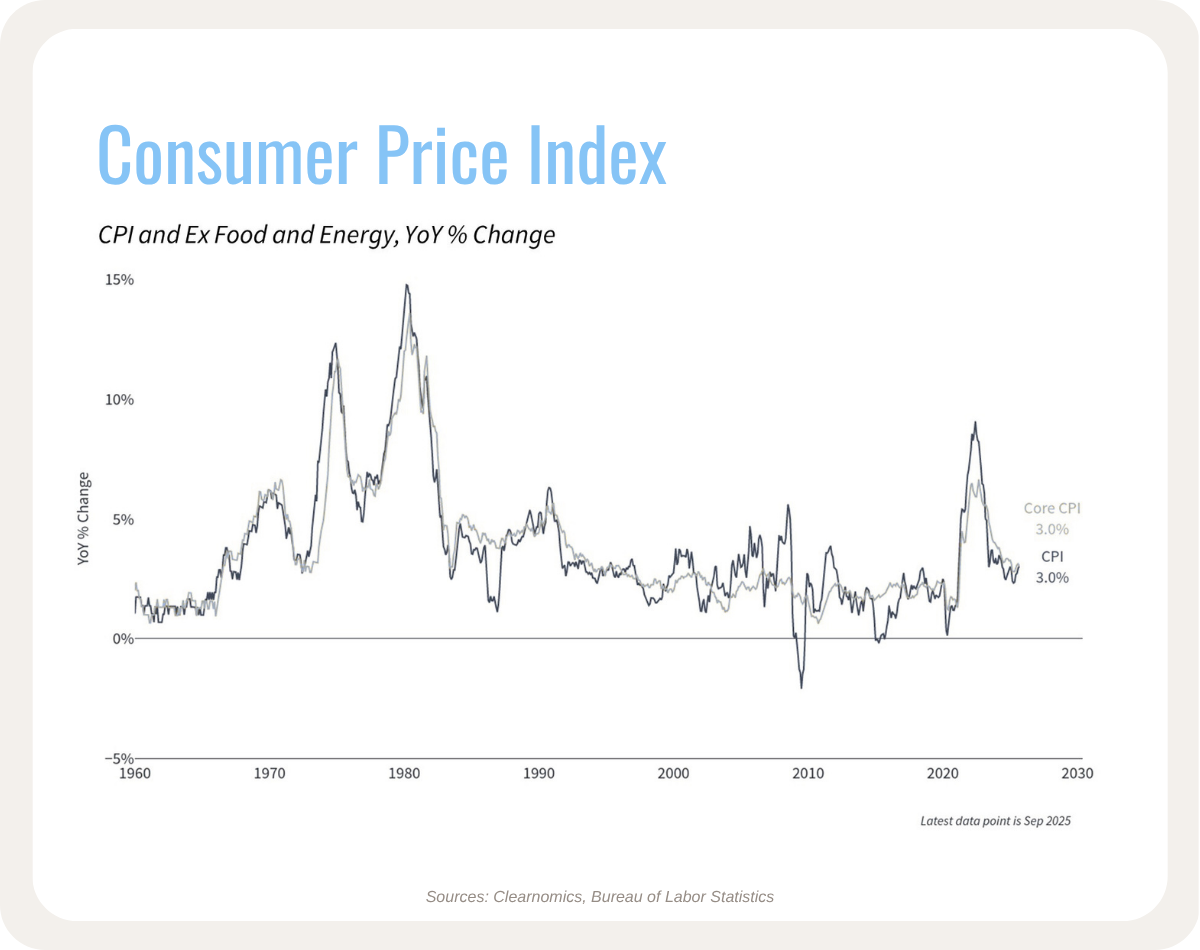
This progress has given the Federal Reserve room to begin lowering interest rates after holding them at restrictive levels. The Fed is also aiming to support a job market that has softened since summer. Historically, lower rates tend to support both stocks and bonds by reducing borrowing costs and increasing the value of existing, higher-yielding bonds.
Inflation and interest rates will continue to shape the market narrative, but the fear of runaway inflation appears to be behind us for now.
A balanced approach to risk and reward
The year ahead will bring its own set of unknowns—just like every year does. When volatility shows up, worries about recessions or the end of a market cycle naturally follow. Instead of reacting to each new headline, long-term investors can stay grounded by maintaining an allocation designed to weather different phases of the economy.

We can be thankful for the variety of asset classes available to help balance risk and opportunity.
Risk management matters throughout an investor’s journey, especially after several years of strong market performance. Today’s S&P 500 price-to-earnings ratio of 22.6x is above average and edging closer to early-2000s levels.
High valuations don’t mean markets can’t continue to rise, but they do suggest that future returns may be more modest compared to areas with more attractive pricing. Setting realistic expectations—and owning a mix of assets with different valuation profiles—helps keep things in balance.
Questions surrounding artificial intelligence will keep coming, and it makes sense—transformative technologies often bring uncertainty.
This was true during the early internet era, too. Layer in political shifts, tariff changes, geopolitical concerns, and conversations about national debt, and it’s clear that reacting emotionally to every development isn’t helpful. In many cases, it can derail progress toward long-term goals.
Confidence Through a Structured Retirement Plan
Last, and most importantly, we can be thankful for having a clear retirement income plan—like a Five-Year Income Plan—that’s built with market pullbacks in mind.
For retirees, knowing that their withdrawals are aligned with their timelines provides real guidance for a well-thought withdrawal strategy. Instead of worrying about short-term volatility, they can draw income from assets specifically set aside for near-term needs while giving long-term investments room to recover and grow.
This kind of structure brings confidence and stability to a stage of life where predictability matters most.
The holidays offer a natural chance to step back, appreciate the progress made, and revisit your portfolio and plan with fresh perspective.
A well-built allocation blends different asset classes and keeps you aligned with your broader goals. That balanced approach alongside a well-thought financial plan remains one of the best ways to navigate whatever challenges and opportunities the new year may bring.
Process over predictions.
Shean